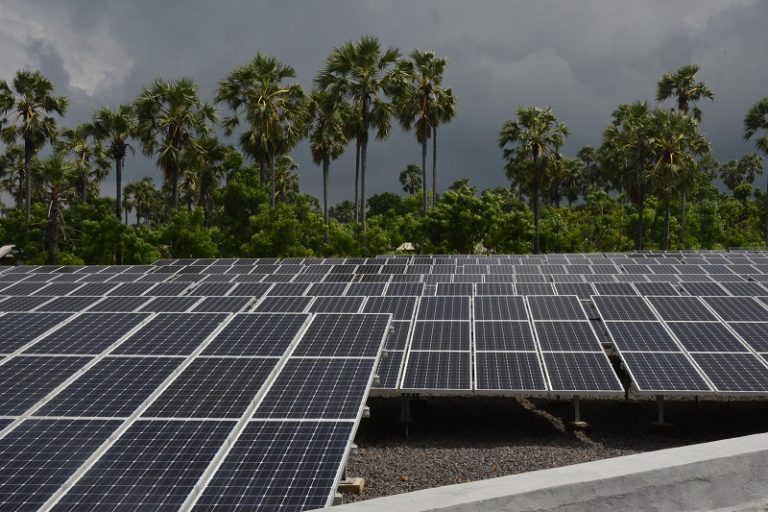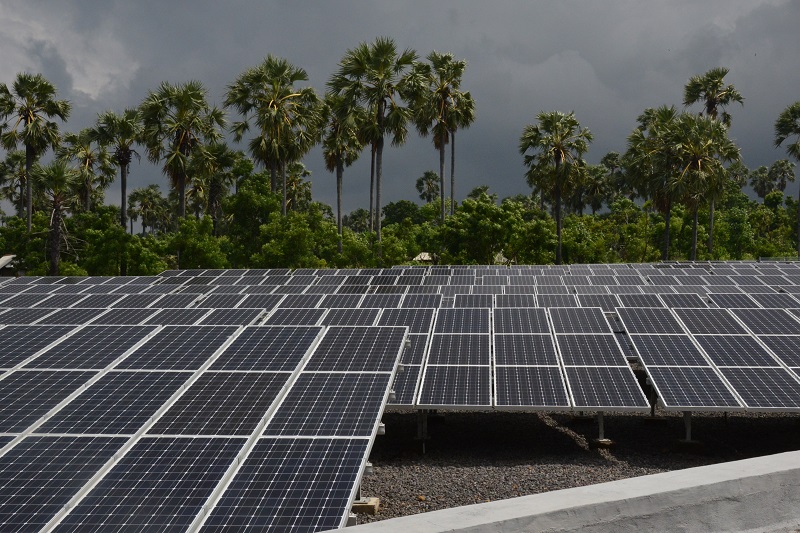
The utilization of solar energy as an alternative energy source to overcome energy crises, particularly regarding petroleum, which has occurred since the 1970s, has received significant attention from many countries worldwide. In addition to its unlimited availability, its utilization does not produce pollution that can damage the environment. Sunlight or solar rays can be converted into electricity using solar cell or photovoltaic technology.
The potential for solar energy in Indonesia is immense, at approximately 4.8 kWh/m2 or equivalent to 112,000 GWp, yet only about 10 MWp has been utilized. Currently, the government has issued a solar energy utilization roadmap targeting an installed solar power plant (PLTS) capacity of 0.87 GW or about 50 MWp/year by 2025. This figure represents a significant potential market for the development of solar energy in the future.
The main component of a solar power plant (PLTS) system using photovoltaic technology is the solar cell. Currently, there are many technologies for manufacturing solar cells. Conventional solar cells that are commercially available today use crystalline silicon wafer technology, which involves a complex and expensive production process. Generally, the manufacturing of conventional solar cells begins with the purification of silica to produce solar-grade silica (ingots), followed by cutting the silica into silica wafers. Subsequently, the silica wafers are processed into solar cells, which are then arranged to form solar modules. The final stage is integrating the solar modules with the BOS (Balance of System) into a PLTS system. BOS refers to the supporting components used in a PLTS system, such as inverters, batteries, control systems, and others.
At present, the development of PLTS in Indonesia has a strong policy-based foundation. However, at the implementation stage, the existing potential has not been optimally utilized. Technologically, the photovoltaic (PV) industry in Indonesia is only capable of operating at the downstream stage—namely, producing solar modules and integrating them into PLTS—while the solar cells themselves are still imported. In fact, solar cells are the main and most expensive component in a PLTS system. High prices remain a critical issue in the development of the solar cell industry. Various solar cell manufacturing technologies continue to be researched and developed in an effort to reduce production costs so they can compete with other energy sources.
Given that the electrification ratio in Indonesia has only reached 55-60%, and almost all areas without electricity are rural regions far from power plants, PLTS—which can be built in almost any location—is a very appropriate alternative to develop. In the period 2005-2025, the government planned to provide 1 million Solar Home Systems with a capacity of 50 Wp for low-income communities and 346.5 MWp of hybrid PLTS for remote areas. By 2025, the government plans to have approximately 0.87 GW of installed PLTS capacity.
Assuming a market share of up to 50%, the solar energy market in Indonesia is large enough to absorb the output of a solar cell factory with a capacity of up to 25 MWp per year. This is certainly a great opportunity for the local industry to expand its business into solar cell manufacturing.
About the Author