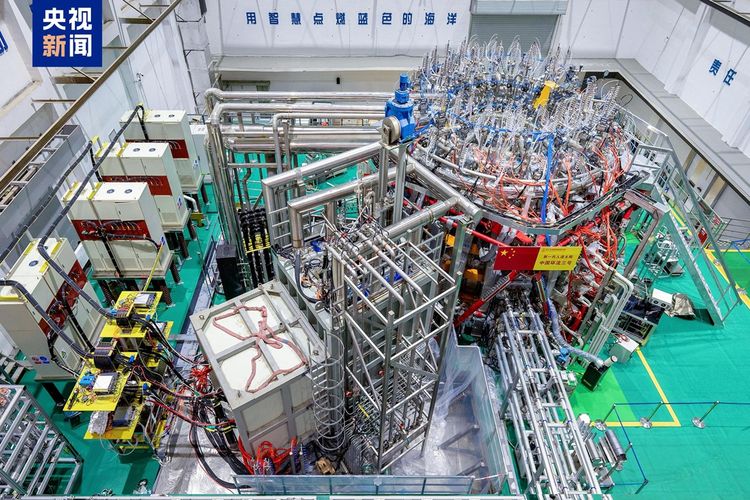
China’s fusion reactor, known as the Experimental Advanced Superconducting Tokamak (EAST), has achieved a groundbreaking milestone. The project, widely referred to as China’s “Artificial Sun,” successfully operated plasma at a density level that was considered impossible for decades.
In its latest experiment, EAST maintained stable plasma at a density of 1.3 to 1.65 times above the Greenwald limit. This theory has long served as the gold standard for the safety and operational limits of tokamak reactors worldwide.
A tokamak machine in a fusion reactor generally functions by confining superheated gas, known as plasma, using powerful magnetic fields. Within this plasma, atomic nuclei collide to produce fusion energy—the same type of energy that powers the Sun.
For a fusion reaction to be effective, the plasma must be both extremely hot and sufficiently dense. The more particles there are within the plasma, the more frequently collisions occur. In fact, in the most commonly studied fusion reactions today, the amount of energy produced is proportional to the square of the plasma density. In short, even a slight increase in density can result in a massive surge in energy output.
However, the challenge lies in the fact that excessive plasma density risks making the tokamak unstable. When this occurs, reactor components can be damaged, and operations may come to an abrupt halt. This is why the Greenwald limit was established as a safety guideline for tokamak reactors.
Remaining Under Control What is remarkable is that EAST did not just momentarily exceed the Greenwald limit. The research team reported that EAST’s plasma remained stable and controlled even when operated far beyond that threshold. In their experiments, the team utilized auxiliary heating techniques from the initial stages of plasma formation and meticulously regulated the initial gas levels.
This approach helps maintain the “plasma edge”—the most vulnerable area to disturbances—preventing it from becoming too cold or unstable.
The EAST researchers also highlighted the critical relationship between the plasma and the reactor walls. According to their observations, plasma does not exist in isolation; it constantly interacts with the surrounding surfaces.
When these interactions are managed effectively, the plasma and the walls can reach a state of relative equilibrium. Under these conditions, the old density limits can be pushed higher without immediately triggering major disruptions.
Unlocking Future Potential This record unlocks significant new potential. If a reactor can operate at 1.3 times the previous limit, the fusion reaction rate could potentially increase by far more than 30 percent.
At 1.65 times the limit, the energy boost could potentially increase several-fold. This means that future fusion reactors could produce significantly more energy without needing to be built larger, hotter, or more technically complex.
Nevertheless, this milestone does not mean that fusion power plants are ready for immediate construction. High density must still be integrated with other critical factors, such as the plasma’s heat confinement capability and the durability of the reactor wall materials.
What is certain is that EAST has sent a powerful signal: the plasma density limits in fusion reactor design are no longer absolute.
About the Author