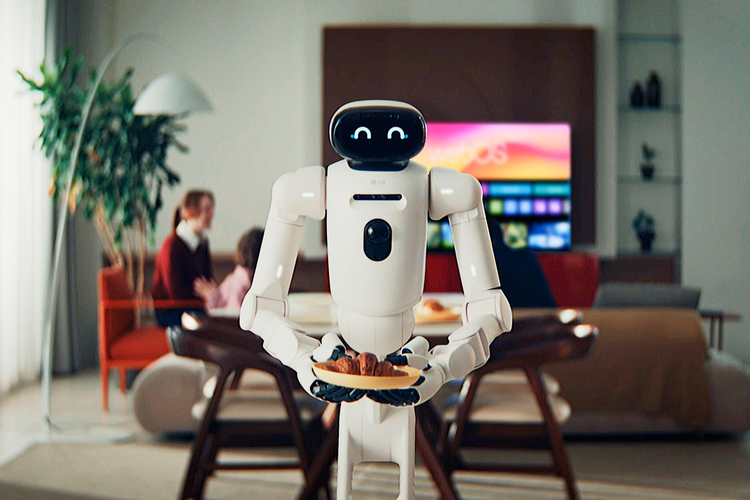
South Korean electronics giant LG Electronics has unveiled its latest AI-powered humanoid robot at the Consumer Electronics Show (CES) 2026 in Las Vegas. Named LG CLOiD, the robot is designed as a domestic assistant capable of performing a wide range of household chores—from folding laundry and washing dishes to serving meals.
CLOiD is a cornerstone of LG’s vision for the “Zero Labor Home”—a smart home concept that is fully automated through the synergy of robotics and AI. This innovation aims to eliminate manual labor, allowing homeowners to reclaim their time while the technology handles the daily grind.
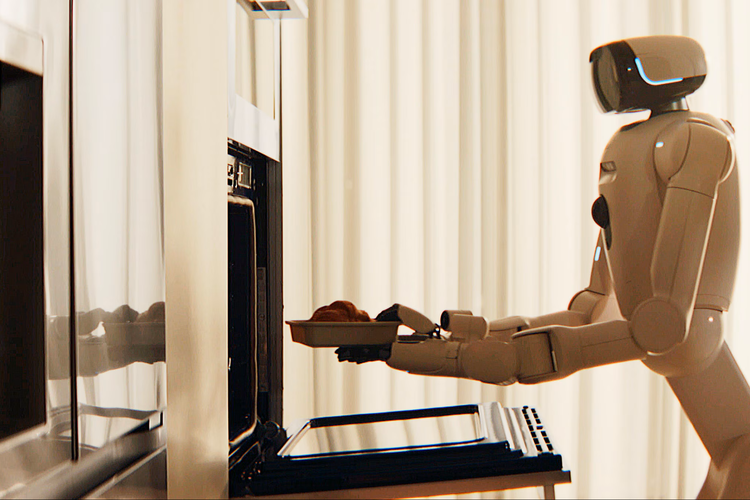
At CES 2026, LG demonstrated CLOiD in a series of real-world home scenarios. In one demonstration, the robot was seen retrieving milk from the refrigerator and placing a croissant into the oven to prepare breakfast.
Once the occupants had left the house, this “domestic assistant” robot proceeded to operate the washing machine, dry the laundry, and then meticulously fold and organize the clothes. This simulation was designed to showcase CLOiD’s ability to understand user habits while seamlessly controlling various household appliances.
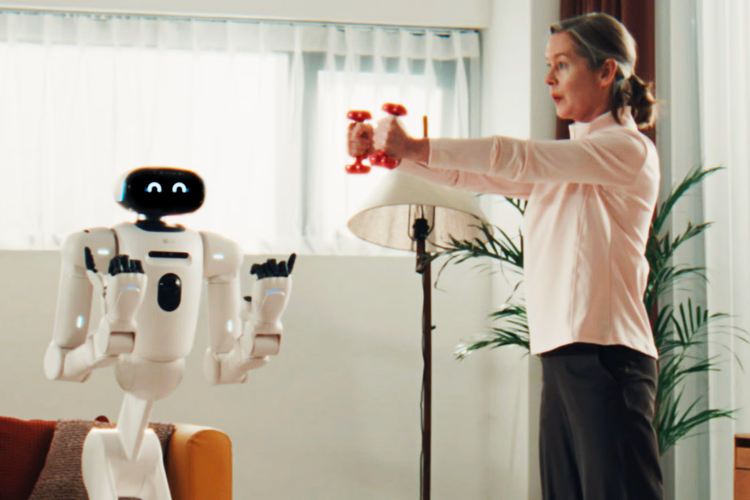
In promotional illustrations, LG also depicted CLOiD assisting with other activities, such as accompanying a user during a home workout. However, the robot’s specific role in this context remains to be fully detailed—it is still unclear whether it acts merely as a companion or provides active instructions and assistance like a fitness instructor.
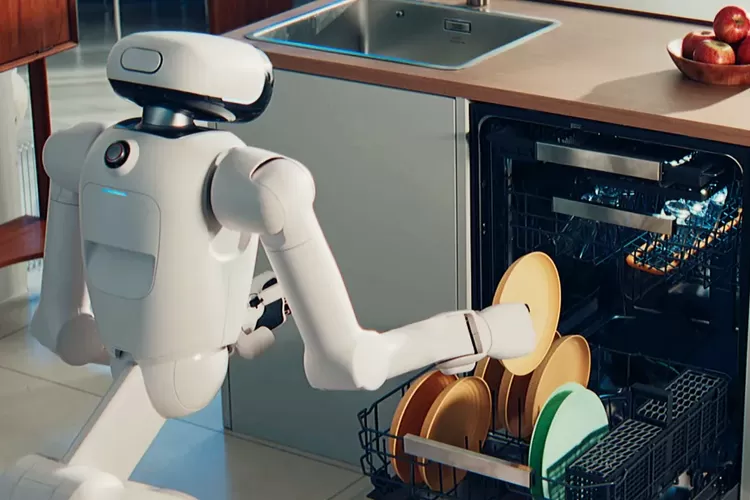
In terms of design, CLOiD appears as a humanoid robot featuring two robotic arms equipped with shoulder, elbow, and wrist joints. Each arm boasts seven degrees of freedom (7DoF), closely mimicking the flexibility of a human arm. These joints enable a full range of motion, including forward, backward, rotational, and lateral movements.
At the extremities, the robotic hands are fitted with five independently moving fingers, allowing CLOiD to handle various objects across the kitchen, laundry room, and living area. LG states that CLOiD’s arms are capable of retrieving items from knee-height up to elevated positions. However, the robot is currently not designed to pick up objects lying directly on the floor.
The head unit of CLOiD functions as a mobile AI home hub. It houses a high-performance chipset that serves as the robot’s “brain,” along with a display, speakers, cameras, various sensors, and voice-based generative AI.
This combination enables CLOiD to communicate through spoken language and visual expressions, while simultaneously learning the home environment and the user’s lifestyle patterns. Based on these insights, the robot can autonomously manage and control smart home devices to better suit the household’s needs.
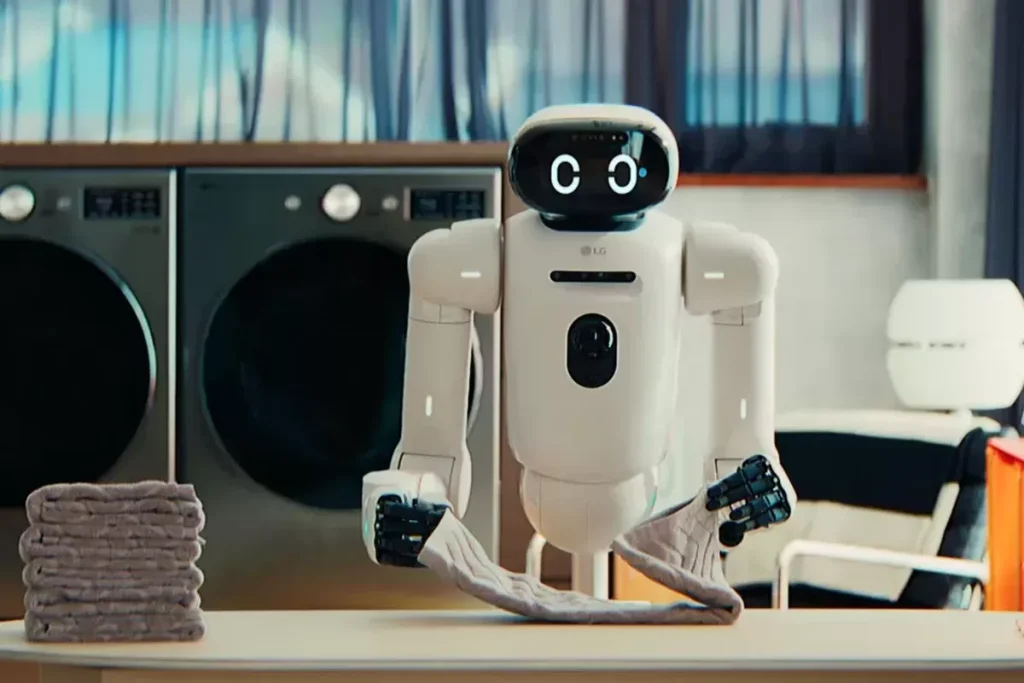
For mobility, CLOiD utilizes a wheeled base, leveraging technology developed from LG’s established line of robotic vacuums. This approach is said to provide the robot with greater stability when navigating a home environment compared to legged humanoid robots.
Powering these capabilities is LG’s proprietary Physical AI technology, which integrates a Vision Language Model (VLM) and a Vision Language Action (VLA) model. The VLM converts images and videos into language-based understanding, while the VLA translates visual and verbal inputs into precise physical actions.
According to LG’s official statement, as reported by KompasTekno, this model was trained using tens of thousands of hours of household activity data. This extensive training enables CLOiD to identify appliances, interpret user intent, and execute context-aware actions—such as opening doors or relocating objects.
CLOiD is also capable of controlling connected smart home devices, specifically within the LG ThinQ and ThinQ ONecosystems. For now, LG emphasizes that CLOiD remains a concept—meaning it is not yet slated for commercial release or consumer sale.
However, attendees at CES 2026 can witness live demonstrations of CLOiD and the Zero Labor Home concept firsthand at the LG booth (#15004, Las Vegas Convention Center).
About the Author