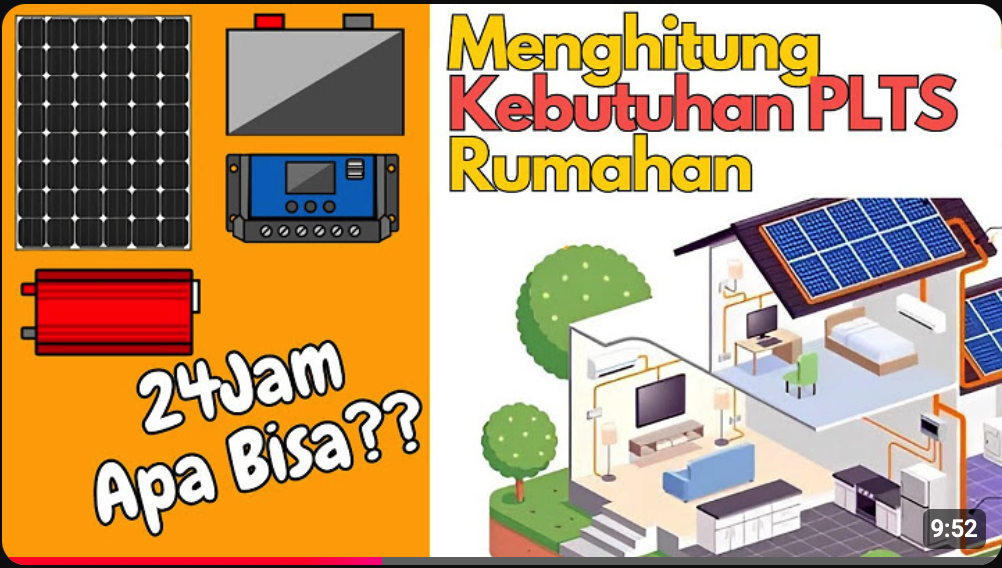
Transitioning to solar energy is a strategic investment for any homeowner. However, the most critical step is “right-sizing” your system. A system that is too small won’t provide significant savings, while one that is too large will have an unnecessarily long payback period.
Here is the professional engineering guide to calculating your Household Scale PLTS needs.
Step 1: Calculate Your Daily Energy Consumption
First, you must determine how much energy your home consumes in 24 hours. You can find this on your monthly PLN bill (look for the kWh usage) or calculate it manually by listing your appliances.
The Formula:
Etotal=∑(Power×Time)
- Example Calculation:
- 1 Air Conditioner (500W) used for 10 hours = 5,000 Wh
- 1 Refrigerator (150W) used for 24 hours = 3,600 Wh
- 10 LED Bulbs (10W) used for 12 hours = 1,200 Wh
- Total Daily Requirement (Etotal): 9,800 Wh (9.8 kWh)
Step 2: Determine Peak Sun Hours (PSH)
Peak Sun Hours refers to the number of hours the sun provides enough intensity to produce maximum power (1,000 W/m2). In Indonesia, the average PSH is approximately 3.5 to 4 hours per day, depending on your location.
Step 3: Calculate Solar Panel Capacity (kWp)
Because there are energy losses in the system (due to heat, cables, and inverter efficiency), we apply a derating factor(usually around 0.75 to 0.8).
The Formula:
Parray=PSH×ηEtotal
- Calculation:
- 9,800 Wh/(4 hours×0.8)=3,062.5 Wp
- Result: You would need a system of approximately 3.1 kWp.
Step 4: Battery Sizing (For Hybrid or Off-Grid Systems)
If you wish to remain powered during the night or during a blackout, you need a battery bank.
The Formula:
CAh=Vsystem×DoDEnight×Days
- Enight: Energy used during non-sunlight hours.
- DoD (Depth of Discharge): 50% for Lead-Acid or 80-90% for Lithium.
Quick Estimation Table for Indonesian Households
| PLN Power Limit | Recommended PLTS Capacity | Estimated No. of Panels (550Wp) |
| 1,300 VA | 1.0 kWp – 1.3 kWp | 2 – 3 Panels |
| 2,200 VA | 2.0 kWp – 2.2 kWp | 4 Panels |
| 3,500 VA | 3.0 kWp – 3.5 kWp | 6 – 7 Panels |
| 5,500 VA | 5.0 kWp – 5.5 kWp | 10 Panels |
Ekspor ke Spreadsheet
Expert Tips from evsolarx.com
- Check Your Roof Orientation: In Indonesia, ensure your panels are facing North or South with a slight tilt (10°–15°) to optimize exposure and allow self-cleaning by rainwater.
- On-Grid vs. Hybrid: If your main goal is reducing bills, an On-Grid system is the most cost-effective. If you want energy independence, a Hybrid system with a battery is the way to go.
- Inverter Capacity: Always choose an inverter that matches the peak load of your household appliances, not just the solar panel output.
About the Author