For many beginners in renewable energy, a 100 Wp (Watt-peak) solar panel is often the first step toward energy independence. However, to build a safe and efficient system, you must understand how to calculate the capacity of the supporting components.
Based on technical standards for small-scale Solar Power Systems (PLTS), here is a comprehensive guide to sizing your system around a 100 Wp panel.
1. Understanding Panel Specifications
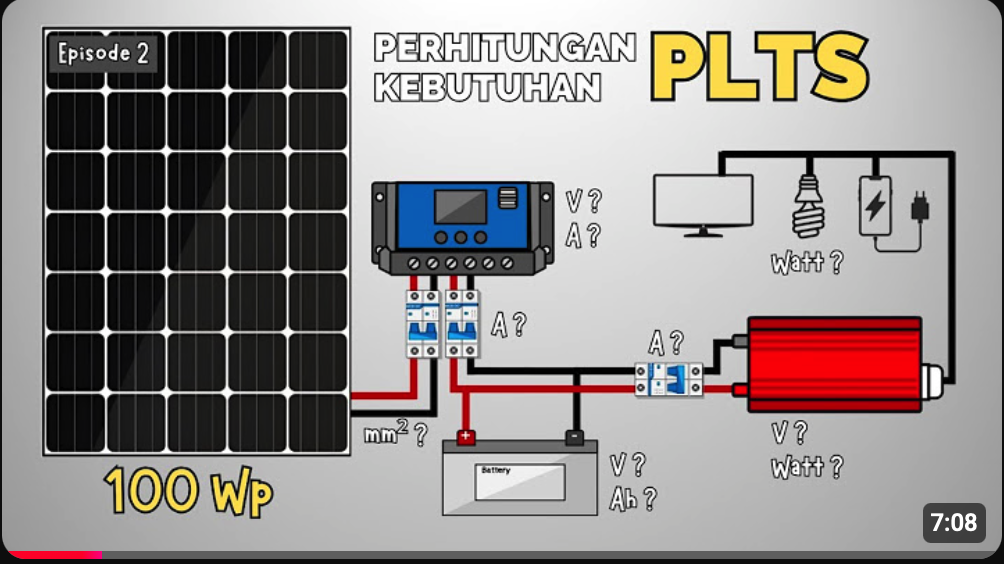
A standard 100 Wp solar panel typically has a Working Voltage (VMP) of around 18 Volts. This voltage is ideal for charging a 12V Battery system, as the charging voltage must be higher than the battery voltage (minimum 14–15 Volts) to ensure a steady flow of energy.
2. Selecting the Core Components
To build a functional 100 Wp system, you will need the following components:
- Solar Charge Controller (SCC): For a small system like this, a 10 Ampere PWM Controller is the most cost-effective and sufficient choice.
- Battery Capacity: A 100 Wp panel produces roughly 400–500 Wh of energy per day. Considering a 50% Depth of Discharge (DoD) for battery longevity, a 35 Ah battery is recommended.
- Inverter: To convert battery power for household appliances, a 300W to 500W Inverter is ideal to handle loads between 100–150 Watts.
3. Safety Standards and Wiring
Safety is paramount in any electrical installation. You must use the correct DC Circuit Breakers (MCB) and cable sizes:
- MCB Placement: * From Panel to SCC: 10A.
- From SCC to Battery: 10A.
- From Battery to Inverter (500W): 50A.
- Cabling: Use 2.5mm to 4mm cables for the panel-to-SCC line. For the battery-to-inverter line, use a thicker 10mm cable to handle high current surges safely.
4. Daily Energy Output: What can it run?
With an average of 4–5 hours of effective sunlight per day, a 100 Wp system generates about 400–500 Wh. This is enough to power:
- Several LED lamps for the entire night.
- Charging multiple smartphones and a laptop.
- A small DC fan or other low-wattage electronics.
About the Author