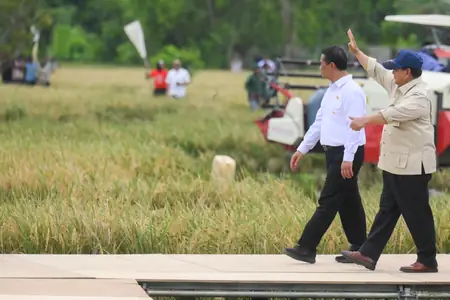
KARAWANG – The residents of Kertamukti Village, Karawang Regency, West Java, witnessed a historic milestone in national development. In early 2026, the government officially announced that Indonesia has reclaimed its food self-sufficiency status, marking the end of dependence on strategic food imports, particularly rice. This achievement is not merely a sectoral success but the primary foundation of national sovereignty.
This historic momentum was announced by President Prabowo Subianto during the Grand Harvest and National Food Self-Sufficiency Announcement 2025, held in Kertamukti Village on Wednesday (Jan 7, 2026). “Today we have recorded a significant victory… On January 7, 2026, I, President Prabowo Subianto, announce that food self-sufficiency has been achieved for the Indonesian people,” the President declared.
Surpassing Targets: Self-Sufficiency in One Year
Remarkably, the success of 2025 was achieved much faster than the government’s initial four-year target. According to the Area Sampling Frame (KSA) from Statistics Indonesia (BPS) as of November 2025:
- National Rice Production: 34.71 million tons (up 13.36% or 4.09 million tons compared to 2024).
- Surplus: Approximately 3.52 million tons.
- Import Status: Indonesia conducted zero imports of consumption rice throughout 2025.
“When I was inaugurated, I set a self-sufficiency target of four years. Thank you to the entire agricultural community. In one year, we have achieved self-sufficiency; in one year, we stand on our own feet,” President Prabowo added. This feat mirrors the 1984 era when Indonesia received global recognition from the FAO.
Integrated Strategy and Policy Reforms
This success was driven by an integrated production strategy:
- Intensification: Strengthening the use of superior seeds, pumping systems (pompanisasi), land optimization, irrigation modernization, and the rejuvenation of agricultural machinery (alsintan).
- Extensification: Accelerating the creation of new rice fields (cetak sawah).
- Governance Reform: Presidential Regulation No. 6/2025 and Agriculture Minister Regulation No. 15/2025 simplified 145 regulations and slashed subsidized fertilizer prices (HET) by 20%.
- Aggressive Absorption: Perum Bulog purchased grain directly from farmers at a competitive price of IDR 6,500 per kg, leading to the largest rice procurement in history.
Prosperous Farmers and a Stronger Economy
Self-sufficiency has directly improved farmers’ welfare. The Farmer Terms of Trade (NTP) reached 125.35 in December 2025—the highest in history. At the macro level, the agricultural sector recorded a GDP growth of 10.52% in Q1 2025, the highest in 15 years.
On the global stage, Indonesia’s decision to stop rice imports caused world rice prices to plummet by 44.2%, from USD 660 to USD 368 per metric ton. Furthermore, agricultural exports reached IDR 629.7 trillion between January and October 2025, a 33.6% year-on-year increase.
Beyond Rice: Corn and Modernization
The success extended to other commodities:
- Corn Production: 16.11 million tons (exceeding the national demand of 15.64 million tons).
- 2026 Outlook: The government has agreed that no corn imports will be needed in 2026.
President Prabowo concluded by reiterating that food self-sufficiency is the ultimate pillar of independence. “No nation is truly independent if it cannot provide food for its people. It is impossible for a nation to be free if its food depends on others,” he emphasized.
About the Author